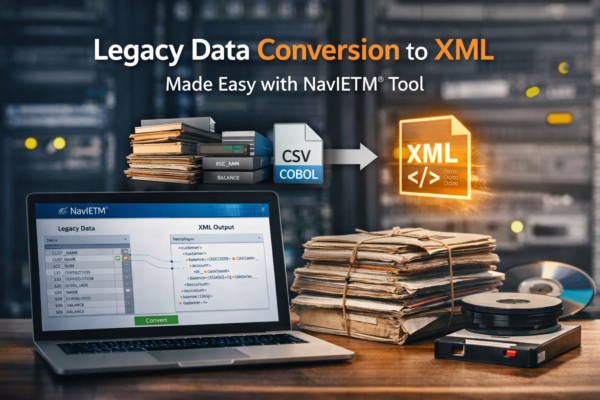
In the modern digital world, data is one of the most valuable assets for any organization. Businesses depend on data to manage operations, analyze performance, and make important decisions. However, many companies still store their critical information in legacy systems that were built many years ago.
These systems often store data in outdated formats that are difficult to integrate with modern applications and platforms. Because of this challenge, organizations need to convert their old data into a more flexible and modern format. One of the most effective solutions is Legacy Data Conversion to XML.
To make this process simple and efficient, NavIETM® provides a powerful tool that helps organizations convert legacy data into XML format quickly and securely.
What is Legacy Data?
Legacy data refers to information stored in old computer systems or outdated technologies. Many organizations continue to use these systems because they contain valuable historical data.
Common examples of legacy data formats include:
- COBOL files
- CSV files
- Fixed-width text files
- Old enterprise databases
- Binary or EBCDIC formats
Although these systems were reliable in the past, they are not compatible with many modern technologies used today.
Because of this limitation, businesses must convert legacy data into formats that can work with modern systems.
What is XML?
XML stands for Extensible Markup Language, a popular format used to store and share structured data.
XML organizes information using tags, which makes it easier to read and process.
XML is widely used because it is:
- Flexible and structured
- Easy to integrate with modern systems
- Supported by web services and APIs
- Compatible with many enterprise platforms
This is why many organizations perform Legacy Data Conversion to XML.
Why Legacy Data Conversion to XML is Important
Converting legacy data into XML helps organizations modernize their data infrastructure.
Better System Integration
XML allows data to move easily between different systems such as CRM software, ERP platforms, and web applications.
Improved Data Accessibility
Structured XML format makes it easier for developers and analysts to access and understand data.
Compatibility with Modern Applications
Most modern applications support XML for data exchange.
Long-Term Data Preservation
XML ensures that valuable legacy data remains usable in future technologies.
How NavIETM® Tool Helps in Legacy Data Conversion
Legacy data conversion can be a complicated process. It often requires data mapping, validation, and restructuring.
This is where NavIETM® provides a powerful tool that simplifies Legacy Data Conversion to XML.
The NavIETM® tool is designed to read legacy data formats, convert them into structured XML, and prepare the data for modern applications.
This automation reduces manual work and increases accuracy during the conversion process.
Key Features of NavIETM® Data Conversion Tool
NavIETM® offers several features that make data conversion easier and more efficient.
Support for Multiple Legacy Formats
The NavIETM® tool supports many legacy data formats such as:
- EBCDIC
- ASCII
- Binary files
- COBOL copybooks
This allows organizations to convert data from various legacy systems.
Automatic Data Mapping
Mapping fields from legacy data to XML tags is one of the most complex steps in data conversion.
NavIETM® automates this process, reducing errors and saving time.
High-Speed Processing
Large organizations often deal with massive datasets.
NavIETM® can process large volumes of data quickly, making it ideal for enterprise environments.
User-Friendly Interface
The tool provides a simple interface with drag-and-drop functionality, making it easy to use even for non-technical users.
Real-World Example
Imagine a banking organization that has stored customer information in a mainframe system for many years.
When the bank wants to launch a new digital banking platform, it needs to migrate its legacy data into a modern system.
Manually converting this data would take significant time and resources.
However, NavIETM® provides a tool that automatically converts the legacy data into XML format, allowing the bank to integrate it with modern applications quickly and efficiently.
Benefits of Using NavIETM®
Organizations using NavIETM® for Legacy Data Conversion to XML gain several benefits.
Faster Data Conversion
Automation allows businesses to convert large datasets quickly.
Cost Efficiency
The tool reduces manual effort and lowers migration costs.
High Data Accuracy
NavIETM® ensures reliable data conversion with minimal errors.
Scalability
The tool can handle both small datasets and large enterprise data volumes.
Data Security and Compliance
Data security is a critical concern during migration.
NavIETM® provides advanced security features including:
- Data encryption
- Secure processing environments
- Detailed audit logs
- Controlled user access
These features ensure that sensitive data remains protected during the conversion process.
Integration with Modern Systems
Once legacy data is converted into XML, it becomes much easier to integrate with modern platforms such as:
- ERP systems
- CRM software
- Cloud platforms
- Web APIs
NavIETM® helps organizations achieve seamless integration with these technologies.The Future of Legacy Data Conversion
As organizations continue to modernize their IT infrastructure, the need for Legacy Data Conversion to XML will continue to increase.
Advanced tools like NavIETM® are now using AI and machine learning technologies to improve automatic data mapping and increase conversion efficiency.
These innovations will make data migration faster and smarter in the future.
Conclusion
Legacy systems contain valuable business data, but their outdated formats often create challenges when integrating with modern technologies.
Legacy Data Conversion to XML is an effective way to modernize old data and make it compatible with new systems.
NavIETM® provides a powerful tool that simplifies this process by automating data conversion, ensuring accuracy, and maintaining data security.
By using NavIETM®, organizations can unlock the full potential of their legacy data and successfully move toward digital transformation.
Frequently Asked Questions (FAQ)
- What is Legacy Data Conversion to XML?
Legacy Data Conversion to XML is the process of transforming data stored in outdated systems into XML format so it can be used with modern applications and technologies.
- Why is XML used for data conversion?
XML is widely used because it provides a structured format that is easy to read, share, and integrate with modern software systems.
- How does NavIETM® help with legacy data conversion?
NavIETM® provides a specialized tool that reads legacy data formats and automatically converts them into structured XML format.
- Is legacy data conversion secure?
Yes, modern tools like NavIETM® provide strong security features such as encryption and secure processing to protect sensitive data during conversion.
- Which industries use legacy data conversion?
Industries such as banking, healthcare, government, and manufacturing commonly use legacy data conversion to modernize their systems.