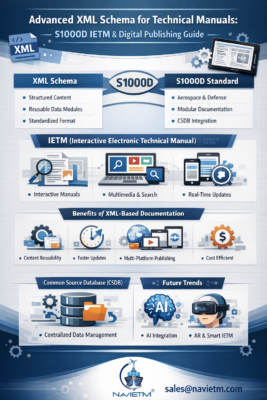
Advanced XML Schema for Technical Manuals
In today’s rapidly evolving digital ecosystem, organizations are shifting from traditional documentation methods to structured XML-based technical manuals. Industries such as aerospace, defense, and heavy engineering demand accuracy, scalability, and efficiency in documentation—this is where advanced XML schema and S1000D standards come into play.
Modern solutions like NavIETM® enable organizations to implement Interactive Electronic Technical Manuals (IETM) and digital publishing systems that streamline content creation, management, and delivery.
This comprehensive guide explores how XML schema enhances technical manuals and why S1000D is the global benchmark for structured documentation.
What is XML Schema in Technical Documentation?
XML Schema (XSD) defines the structure and rules of XML documents. In technical manuals, it ensures that every piece of content follows a standardized format.
Key Functions of XML Schema:
- Defines elements and attributes
- Enforces data validation rules
- Maintains content consistency
- Enables automation in publishing
Unlike unstructured formats, XML allows content to be modular and reusable, making it highly efficient for complex technical documentation.
Deep Dive into S1000D Standard
S1000D is not just a documentation format—it is a complete framework for managing technical publications.
Core Components of S1000D:
- Data Modules: Small, reusable content units
- DMC (Data Module Code): Unique identifiers for each module
- BREX (Business Rules Exchange): Defines project-specific rules
- Illustrations & Multimedia Integration
Industries Using S1000D:
- Aerospace & Aviation
- Defense & Military
- Rail & Transportation
- Energy & Manufacturing
By adopting S1000D XML schema, organizations ensure interoperability and long-term sustainability of documentation.
How Advanced XML Schema Enhances Technical Manuals
Advanced XML schema goes beyond basic structuring and introduces intelligent content management capabilities.
1. Structured Authoring
Authors create content in predefined templates, ensuring uniformity.
2. Intelligent Validation
Errors are automatically detected during content creation.
3. Content Reusability
Modules can be reused across different manuals and projects.
4. Seamless Integration
XML integrates with enterprise systems like:
- ERP
- Maintenance systems
- IETM viewers
5. Scalability
Handles large volumes of documentation efficiently.
IETM – Transforming Static Manuals into Interactive Systems
Interactive Electronic Technical Manuals (IETM) revolutionize how users interact with technical content.
Key Features:
- Advanced search functionality
- Hyperlinked navigation
- Embedded videos and diagrams
- Real-time updates
- Mobile and tablet compatibility
With solutions like NavIETM®, organizations can deliver user-friendly digital manuals that enhance operational efficiency.
Common Source Database (CSDB): The Backbone of S1000D
A Common Source Database (CSDB) stores all XML data modules and manages documentation workflows.
Core Functions:
- Centralized content repository
- Version control and tracking
- Workflow automation
- Access control and security
Benefits of CSDB:
- Eliminates duplication
- Ensures consistency
- Improves collaboration
- Speeds up publishing
NavIETM® offers robust CSDB solutions tailored for enterprise documentation needs.
End-to-End Digital Publishing Workflow
An XML-based workflow ensures efficient documentation lifecycle management.
Step 1: Content Creation
Authors use XML editors to create structured content.
Step 2: Schema Validation
Content is validated against XML schema rules.
Step 3: Storage in CSDB
Validated modules are stored centrally.
Step 4: Content Transformation
Publishing engines convert XML into:
- HTML
- Mobile formats
Step 5: Delivery via IETM
End-users access manuals through interactive platforms.
Advanced Capabilities of XML-Based Documentation
1. Modular Documentation
Break large manuals into manageable sections.
2. Multi-Language Support
Easily translate content for global audiences.
3. Conditional Content
Display content based on user roles or scenarios.
4. Automation & AI Integration
Automate repetitive tasks and improve efficiency.
5. Real-Time Updates
Instant updates without republishing entire manuals.
Advantages of XML Technical Documentation
Structured XML content is not only beneficial for documentation but also improves search engine performance.
SEO Benefits:
- Better indexing through structured data
- Faster loading pages
- Enhanced user experience
- Higher chances of featured snippets
When integrated with web publishing, XML helps technical content rank higher in search results.
Challenges in Implementing S1000D XML Schema
Despite its benefits, organizations may face challenges such as:
- Complex initial setup
- Requirement for skilled professionals
- Integration with legacy systems
- Higher upfront investment
However, expert platforms like NavIETM® simplify implementation and reduce operational complexity.
Why NavIETM® is the Right Choice
NavIETM® provides cutting-edge solutions for XML-based documentation.
Key Offerings:
- S1000D-compliant XML schema
- Advanced IETM viewer software
- Scalable CSDB solutions
- Custom digital publishing systems
- End-to-end implementation support
Their expertise ensures smooth digital transformation for technical documentation.
Future Trends in XML & Technical Documentation
The future of technical manuals is driven by innovation and automation.
Emerging Trends:
- AI-powered documentation systems
- Smart IETM with predictive analytics
- Cloud-based CSDB solutions
- Voice-enabled technical manuals
- Augmented Reality (AR) integration
These advancements will further enhance the usability and efficiency of technical manuals.
Best Practices for XML Schema Implementation
To maximize ROI and efficiency:
- Use standardized frameworks like S1000D
- Maintain modular content structure
- Invest in training and tools
- Regularly validate XML data
- Ensure proper version control
Real-World Use Case of XML in Technical Manuals
Consider an aerospace company managing thousands of pages of maintenance manuals.
Without XML:
- Repetitive content
- High error rates
- Difficult updates
With XML & S1000D:
- Modular reusable content
- Faster updates
- Improved accuracy
- Efficient publishing
This demonstrates how XML schema transforms documentation processes.
Conclusion
Advanced XML schema has become the foundation of modern technical documentation. With standards like S1000D, organizations can create structured, scalable, and efficient manuals that meet global requirements.
By leveraging platforms like NavIETM®, businesses can implement IETM, CSDB, and digital publishing solutions seamlessly. As industries continue to digitize, adopting XML-based documentation is essential for staying competitive and future-ready.
NavIETM® is a complete platform that provides all these tools including XML schema, S1000D compliance, CSDB, and IETM solutions in one integrated system.”
FAQs
Q1: What is the S1000D XML schema?
It is a standardized XML framework used to create structured and reusable technical manuals.
Q2: What is IETM software used for?
IETM software provides interactive digital manuals with search, multimedia, and real-time updates.
Q3: What is the purpose of CSDB?
CSDB stores and manages all technical documentation modules in a centralized system.
Q4: Why is XML important in technical publishing?
XML ensures structured, reusable, and easily maintainable content.