CSDB for S1000D Explained: Features, Benefits & Use Cases
In today’s digital era, industries such as aerospace, defence, railways, and manufacturing handle massive amounts of technical data. Managing this data efficiently is essential for smooth operations, compliance, and safety. Traditional documentation methods often fail to meet these growing demands.
This is where CSDB (Common Source Database) for S1000D becomes a game-changing solution.
we will explain what CSDB is, how it works with S1000D, its key features, benefits, and real-world use cases.
What is CSDB?
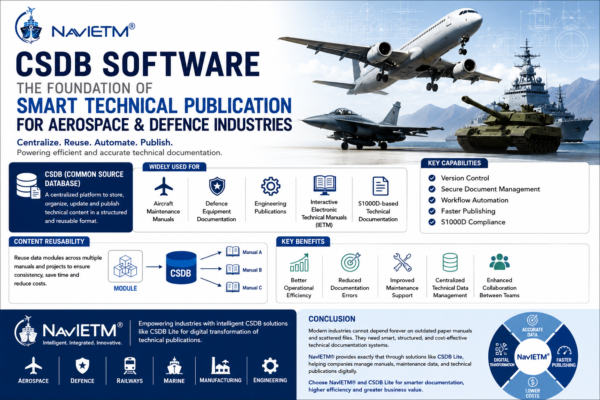
A Common Source Database (CSDB) is a centralized system used to store and manage technical documentation in a structured format. Instead of saving documents as large files, CSDB breaks them into smaller reusable units known as Data Modules.
These modules can be reused across multiple manuals and projects, making documentation faster, more accurate, and cost-effective.
.png)
What is S1000D?
S1000D is an international standard used for creating and managing technical documentation. It is widely used in industries where accuracy and consistency are critical.
S1000D ensures:
- Structured documentation
- Easy updates and maintenance
- Reusability of content
- Standardization across projects
When CSDB is used with S1000D, it creates a powerful system for managing complex technical data.
How CSDB Works with S1000D
CSDB acts as the backbone of the S1000D documentation system. It stores all the data modules, images, and metadata in a structured format.
Here’s how it works:
- Content is created in small modules (Data Modules)
- Modules are stored in the CSDB
- These modules are reused across different manuals
- Updates are made once and reflected everywhere
- Content is published as IETM or PDF
This approach improves efficiency and reduces duplication.
Key Features of CSDB for S1000D
Centralized Data Storage
All documentation is stored in one place, making it easy to manage and access.
Modular Content System
Content is divided into reusable data modules.
Version & Change Management
Track updates, revisions, and maintain document history.
Multi-Format Publishing
Publish documents in IETM, PDF, and digital formats.
Schema & Validation Support
Ensures all content follows S1000D standards.
Access Control & Security
Control who can view or edit documents.
Benefits of Using CSDB for S1000D
- Improved efficiency
- Content reusability
- Higher accuracy
- Faster updates
- Cost reduction
- Better collaboration
Use Cases of CSDB for S1000D
Aerospace Industry
Used for aircraft maintenance manuals and operational guides.
Defense Sector
Helps manage complex military documentation and compliance.
Railways
Used for maintenance, safety, and operational manuals.
Manufacturing
Manages machine documentation and service manuals.
Oil & Gas
Ensures proper documentation of equipment and safety procedures.
Conclusion
CSDB for S1000D is a powerful solution that transforms how technical documentation is created, managed, and delivered. With features like modular content, reusability, and centralized control, it helps businesses improve efficiency and reduce costs.
If your organization deals with complex technical data, implementing a CSDB system is the right step toward digital transformation.